


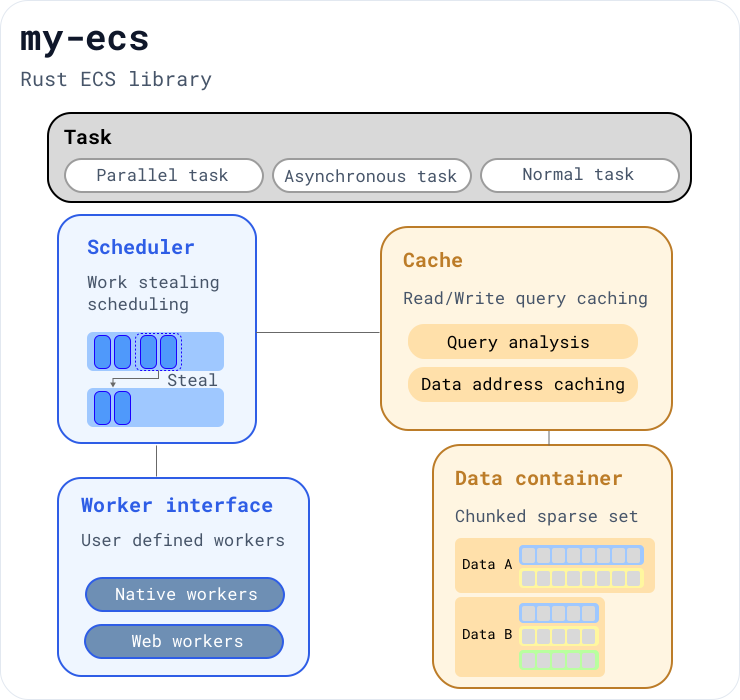
my-ecs is an Entity Component System library for Rust with parallel system
execution, built-in async task integration, and wasm32 support.
- Parallel scheduling by default.
Systems can run across multiple worker threads while
my-ecsenforces data access rules for components, entities, and resources. - Explicit data access. Systems declare what they read or write, and the scheduler uses that information to order execution safely.
- Async integration. Systems can enqueue futures through the built-in posting/execution flow, which makes it practical to mix ECS logic with async work.
- Native and web targets.
The crate supports native workers and includes web-worker support for
wasm32-unknown-unknown.
Component: plain data attached to entities.Entity: a collection of components.System: logic that reads or writes ECS data.Resource: unique global data stored once in the world.Filter/Select: type-level queries created with thefilter!macro.
my-ecs-demo-small.mp4 |
Rendering the Mandelbrot set with multiple threads using my-ecs Try the demo here |
Add the crate:
[dependencies]
my-ecs = "0.1"
Define components with ordinary Rust types:
use my_ecs::prelude::*;

#[derive(Component)]
struct Position {
    x: u32,
    y: u32,
}
Define an entity as a named bundle of components:
use my_ecs::prelude::*;

#[derive(Component)]
struct Position {
    x: u32,
    y: u32,
}

#[derive(Component)]
struct Movable;

#[derive(Entity)]
struct MovableObject {
    pos: Position,
    movable: Movable,
}
Define a selector with filter!, then read or write matching components from a
system:
use my_ecs::prelude::*;

#[derive(Component)]
struct Position {
    x: u32,
    y: u32,
}

filter!(Fpos, Target = Position);

fn moves(mut w: Write<Fpos>) {
    for Position { x, y } in w.iter_mut().flatten() {
        *x += 10;
        *y += 10;
    }
}
Resources are singletons:
use my_ecs::prelude::*;

#[derive(Resource)]
struct Count(u32);

Ecs::create(WorkerPool::new(), [])
    .add_resource(Count(0))
    .add_once_systems((
        |rw: ResWrite<Count>| rw.take().0 += 1,
        |rr: ResRead<Count>| println!("{}", rr.take().0),
    ))
.step();This example registers two entity types, creates data, mutates one subset, then prints the result.
use my_ecs::prelude::*;

#[derive(Component)]
struct Position {
    x: u32,
    y: u32,
}

#[derive(Component)]
struct Movable;

#[derive(Entity)]
struct Object {
    pos: Position,
}

#[derive(Entity)]
struct MovableObject {
    pos: Position,
    _m: Movable,
}

filter!(Fpos, Target = Position);
filter!(Fmovpos, Target = Position, All = Movable);

fn main() {
    Ecs::create(WorkerPool::with_len(2), [2])
        .register_entity_of::<Object>()
        .register_entity_of::<MovableObject>()
        .add_once_systems((create, print, moves, print))
        .step();
}

fn create(ew: EntWrite<(Object, MovableObject)>) {
    let (mut obj_container, mut mov_container) = ew.take_recur();

    obj_container.add(Object {
        pos: Position { x: 1, y: 2 },
    });
    mov_container.add(MovableObject {
        pos: Position { x: 3, y: 4 },
        _m: Movable,
    });
}

fn moves(mut w: Write<Fmovpos>) {
    for Position { x, y } in w.iter_mut().flatten() {
        *x += 10;
        *y += 10;
    }
}

fn print(r: Read<Fpos>) {
    for container in r.iter() {
        for Position { x, y } in container.iter() {
            println!("{}: ({x}, {y})", container.entity_name().unwrap());
        }
    }
}Parallel execution depends on explicit access declarations. Reads may run together, while writes are exclusive.
fn read_components(v: Read<A>) { /* ... */ }
fn write_components(v: Write<B>) { /* ... */ }
fn read_resource(v: ResRead<C>) { /* ... */ }
fn write_resource(v: ResWrite<D>) { /* ... */ }
fn write_entity(v: EntWrite<E>) { /* ... */ }
Because systems state their access up front, my-ecs can detect dependency
conflicts and schedule safe execution automatically.
examples/parallel.rs: usingrayonwith ECS-aware parallel iteration.examples/async.rs: posting futures and applying their results back into the ECS world.examples/async_io.rs: separating async I/O work from compute-heavy work by worker group.demo/: a browser demo that renders the Mandelbrot set withmy-ecs.
Most applications can start with:
use my_ecs::prelude::*;The prelude re-exports the main ECS API, derive macros, helper macros, and
rayon::prelude::*.