Design Intro
User Experience (UX) involves a person's behaviors, attitudes, and emotions about using a particular product, system or service. User experience encompasses all aspects of the end-user's interaction with the company, its services, and its products. That includes not only while using the application itself but also the emails you receive, how easy the login flow may be, and how soon you get a response after submitting a support request.
The first requirement for a great user experience is to meet the exact needs of the customer, without fuss or bother. Next comes simplicity and elegance that produce products that are a joy to own, a joy to use. True user experience goes far beyond giving customers what they say they want, or providing checklist features. In order to achieve high-quality user experience in a company's offerings there must be a seamless merging of the services of multiple disciplines, including engineering, marketing, graphical and industrial design, and interface design. One of the best current examples of a company that provides a great user experience from top to bottom is Apple.
Here are some of the factors that make Apple stand out against their competitors:
- Seamless integration of hardware and software in their products
- Memorable, slick marketing campaigns
- A superior retail experience in Apple stores
- Software is fun to use and interact with
- When you call their support a person answer immediately
Apple has even managed to make the unboxing of their products a great part of the experience.

A user story is an explanation, in a few sentences, of what a user needs to do while using a product. User stories are common in agile software development and answer the question of who, what, and why in a simple way.
Examples user stories:
Dropbox
As a user, I can easily sync files across all of my devices.
As a user, I can see easily what my friends and family are up to and share my own experiences.
A microwave
As a user, I can easily heat up my leftovers.
User stories are, you guessed it, heavily dependent on the characteristics and different types of users. Some products may have only one main type of user while others have dozens of categories.
The user interface is the space where interaction between humans and machines occurs. Humans should be able to easily control machines and receive feedback on the best way to proceed. Microwaves are very straightforward in their approach. You have a keypad to set the time, presets for certain types of food, start and stop buttons, and a display that primarily shows you the time left when something is cooking but also shows the time of day when the microwave is not in use.

Wireframes are like blueprints for websites. They show various screens that will eventually be developed into a useable application. Wireframes help show how an application will function and how to navigate through an application and don't typically make use of colors, graphics, or any styling. Wireframes can be made on a whiteboard, paper, or on the computer.
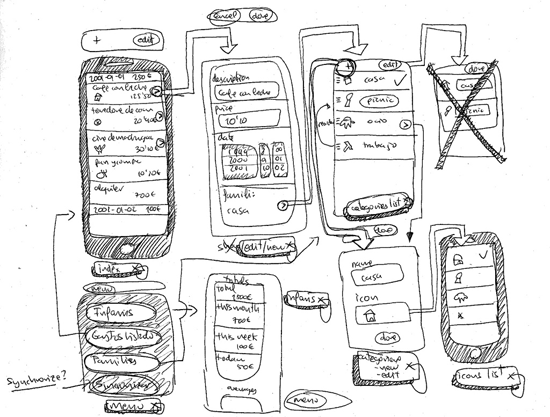
Create a free account on Balsamiq and play around with creating some basic wireframes
Colors are important. Different colors evoke different emotions, provide varying amounts of contrast, and ultimately have an affect on how users feel while using a product. Read more about color theory here.


A logo is the graphical mark used to represent your brand. Logos are either purely graphical, using just a symbol, purely text-based, or both.

Icons serve an important place in web design. They help users navigate without using text links and help enrich interfaces without taking up a lot of space.

Sometimes people think web design and graphic design are interchangeable or that if you're good at one you're automatically good at the other. While they do relate to one another in several ways that is not the case. Graphic design is a much older practice rooted in creating designs that are meant to be printed. Graphic designers tend to be highly artistic, are often great at drawing, and work a lot with Adobe Creative Suite products like Illustrator and Photoshop. Web designers deal more so with how a design will work in the context of the web, how realistic is may be in regard to usability, and are more likely to work on the coding side of things with HTML and CSS. Graphic designers are often responsible for creation of assets like the logo, icons, and various marketing material.

KISS is an acronym for "Keep it simple, stupid" as a design principle noted by the U.S. Navy in 1960. The KISS principle states that most systems work best if they are kept simple rather than made complicated; therefore simplicity should be a key goal in design and unnecessary complexity should be avoided. Read more on that here


Keeping it simple is harder than it seems. You're forced to think about what are the most essential elements to display to the user and how to best get them to do what you want.