subpixel averaging for boundaries of variable-material objects#1399
Open
stevengj wants to merge 4 commits into
Open
subpixel averaging for boundaries of variable-material objects#1399stevengj wants to merge 4 commits into
stevengj wants to merge 4 commits into
Conversation


stevengj
commented
Mar 31, 2021
| /* check for trivial case of only one object/material */ | ||
| if (material_type_equal(mat, mat_behind)) { | ||
| if (is_variable(mat)) eval_material_pt(mat, vec_to_vector3(v.center())); | ||
| goto trivial; |
Collaborator
Author
There was a problem hiding this comment.
In #1539, this will branch to the new averaging procedure if mat is a variable material.
 stevengj
force-pushed
the
subpixel_varmat
branch
from
stevengj
force-pushed
the
subpixel_varmat
branch
from
d0b870d to
4c02faf
Compare
stevengj
force-pushed
the
subpixel_varmat
branch
from
ce93958 to
bf5296c
Compare
stevengj
commented
Feb 17, 2022
| const geometric_object **o_front, vector3 &shiftby_front, | ||
| material_type &mat_front, material_type &mat_behind) { | ||
| material_type &mat_front, material_type &mat_behind, | ||
| vector3 &p_front, vector3 &p_behind) { |
Collaborator
Author
There was a problem hiding this comment.
Note that we added p_front and p_behind here — this is so that we have a point to evaluate the material at if it is a variable materials (grid or user).

This file contains hidden or bidirectional Unicode text that may be interpreted or compiled differently than what appears below. To review, open the file in an editor that reveals hidden Unicode characters.
Learn more about bidirectional Unicode characters
Sign up for free
to join this conversation on GitHub.
Already have an account?
Sign in to comment
1 participant

Add this suggestion to a batch that can be applied as a single commit.This suggestion is invalid because no changes were made to the code.Suggestions cannot be applied while the pull request is closed.Suggestions cannot be applied while viewing a subset of changes.Only one suggestion per line can be applied in a batch.Add this suggestion to a batch that can be applied as a single commit.Applying suggestions on deleted lines is not supported.You must change the existing code in this line in order to create a valid suggestion.Outdated suggestions cannot be applied.This suggestion has been applied or marked resolved.Suggestions cannot be applied from pending reviews.Suggestions cannot be applied on multi-line comments.Suggestions cannot be applied while the pull request is queued to merge.Suggestion cannot be applied right now. Please check back later.
This PR implements subpixel averaging for the boundaries of objects with variable materials (e.g. user-defined material functions). I realized that we can still handle this case accurately and efficiently, as long as the material function is continuous inside the object.
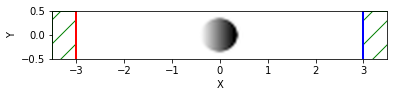
For example, here is a simulation of transmitted power through a cylinder of linearly-varying ε:
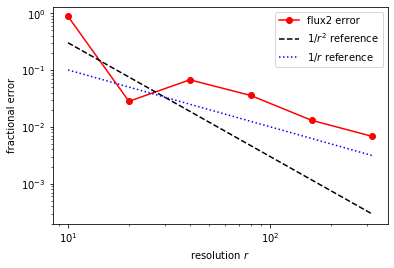
If I compute and plot the convergence with respect to resolution using this code:
then before this PR I get first-order convergence due to the lack of subpixel averaging at the boundaries of the cylinder:
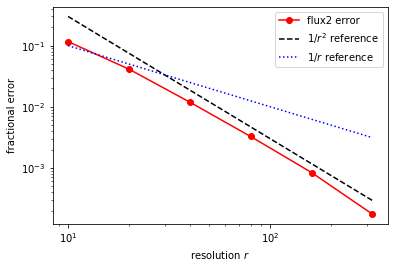
but after this PR I get second-order convergence: