
Skip to content

DOKOS-TAYOS/Tensor-Network-Visualization

Tensor-Network-Visualization

CI PyPI version Python versions License: MIT

Minimal Matplotlib visualizations for TensorKrowch, TensorNetwork, Quimb, TeNPy, and traced PyTorch/NumPy einsum tensor networks.

Repository: https://github.com/DOKOS-TAYOS/Tensor-Network-Visualization

What This Library Does

Tensor-network libraries expose very different Python objects, but this package gives them two aligned plotting entry points:

fig, ax = show_tensor_network(...)
fig, ax = show_tensor_elements(...)

Internally, the library:

  1. normalizes backend objects into one graph model,
  2. computes a layout,
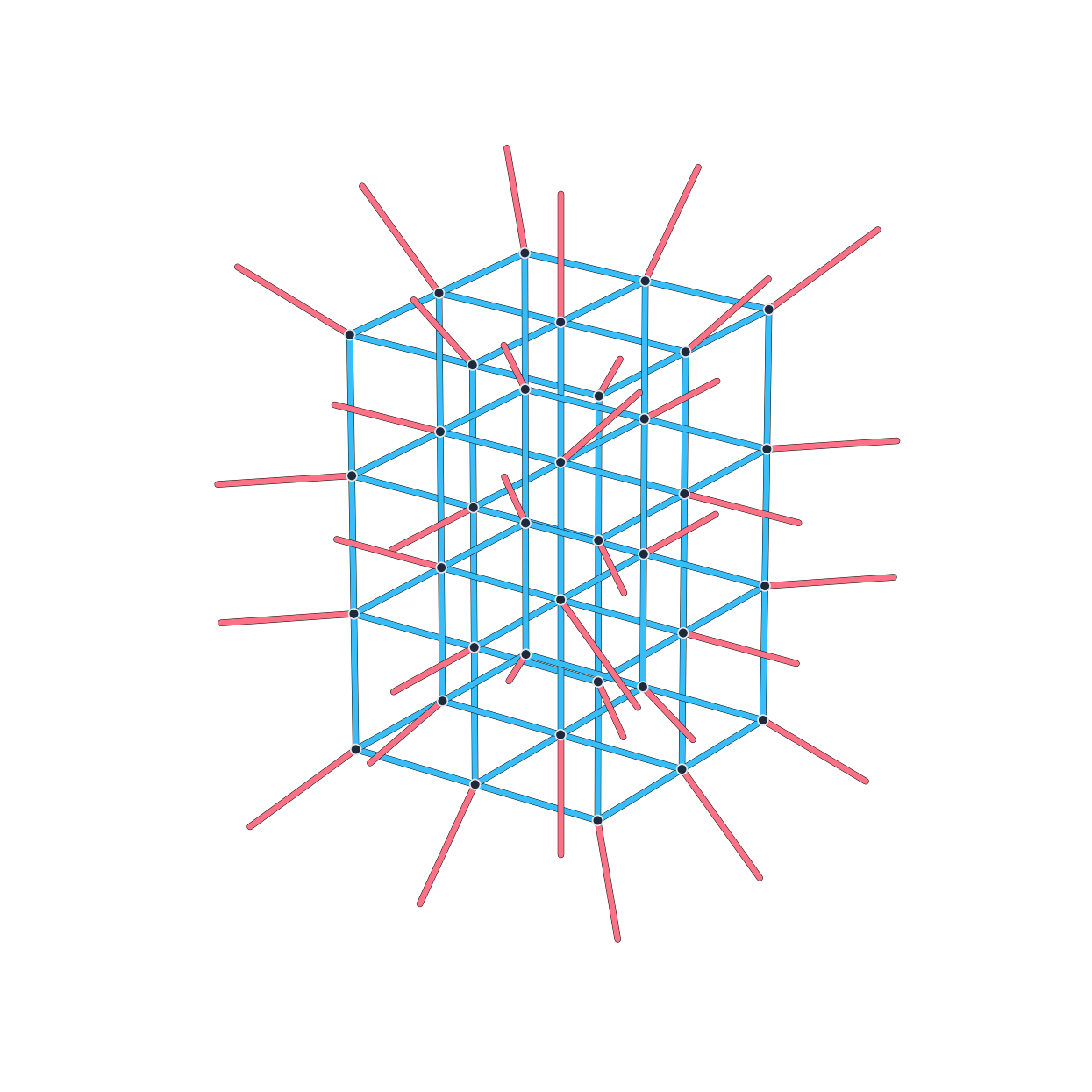
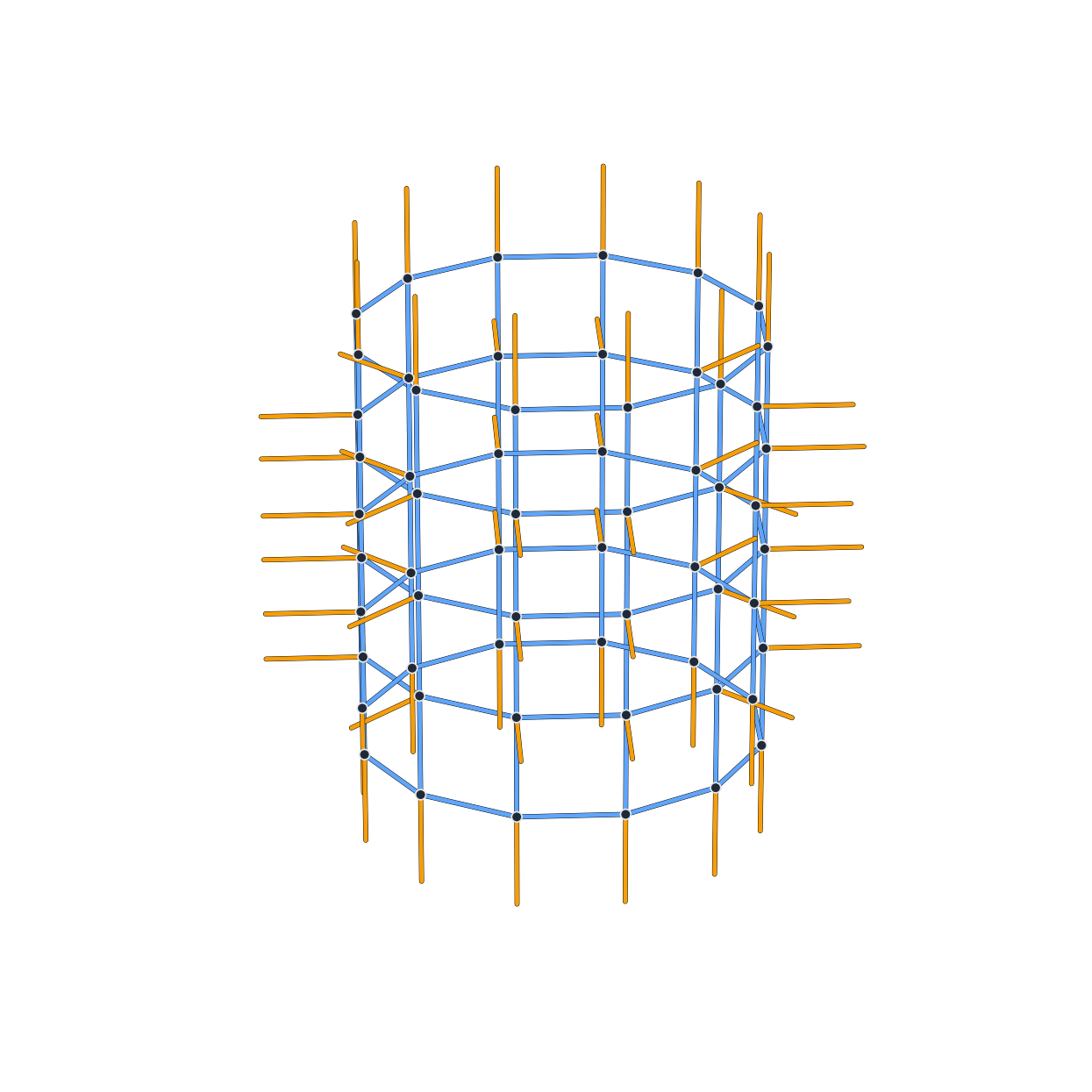
  3. draws the graph in 2D or 3D with Matplotlib,
  4. optionally adds figure controls for view/label/scheme toggles.

The goal is to keep the public API small while still being useful for notebooks, papers, debugging, and saved figures.

Install

PyPI package name: tensor-network-visualization
Import package: tensor_network_viz

Requires Python 3.11 or newer.

Base install

python -m pip install tensor-network-visualization

Base dependencies are only numpy, matplotlib, and networkx.

Optional extras

Need Install
TensorKrowch support python -m pip install "tensor-network-visualization[tensorkrowch]"
TensorNetwork support python -m pip install "tensor-network-visualization[tensornetwork]"
Quimb support python -m pip install "tensor-network-visualization[quimb]"
TeNPy support python -m pip install "tensor-network-visualization[tenpy]"
Traced einsum(...) support python -m pip install "tensor-network-visualization[einsum]"
Interactive Jupyter widgets python -m pip install "tensor-network-visualization[jupyter]"

Windows and Linux quick start

Windows (PowerShell):

python -m venv .venv
.\.venv\Scripts\Activate.ps1
python -m pip install -U pip
python -m pip install "tensor-network-visualization[quimb]"

Linux / macOS:

python3 -m venv .venv
source .venv/bin/activate
python -m pip install -U pip
python -m pip install "tensor-network-visualization[quimb]"

The API in One Minute

show_tensor_network

Use show_tensor_network for figure lifecycle:

show_tensor_network(
    network,
    *,
    engine=None,
    view=None,
    config=None,
    ax=None,
    show_controls=True,
    show=True,
)
  • engine: optional backend override. If omitted, the library auto-detects it.
  • view: "2d" or "3d". If omitted, it starts in "2d".
  • config: all visual behavior lives here.
  • ax: render into an existing Matplotlib axis.
  • show_controls: if False, the figure is saved/rendered without the embedded control panel.
  • show: if False, nothing is displayed automatically.

show_tensor_elements

Use show_tensor_elements to inspect tensor values:

show_tensor_elements(
    data,
    *,
    engine=None,
    config=None,
    ax=None,
    show_controls=True,
    show=True,
)

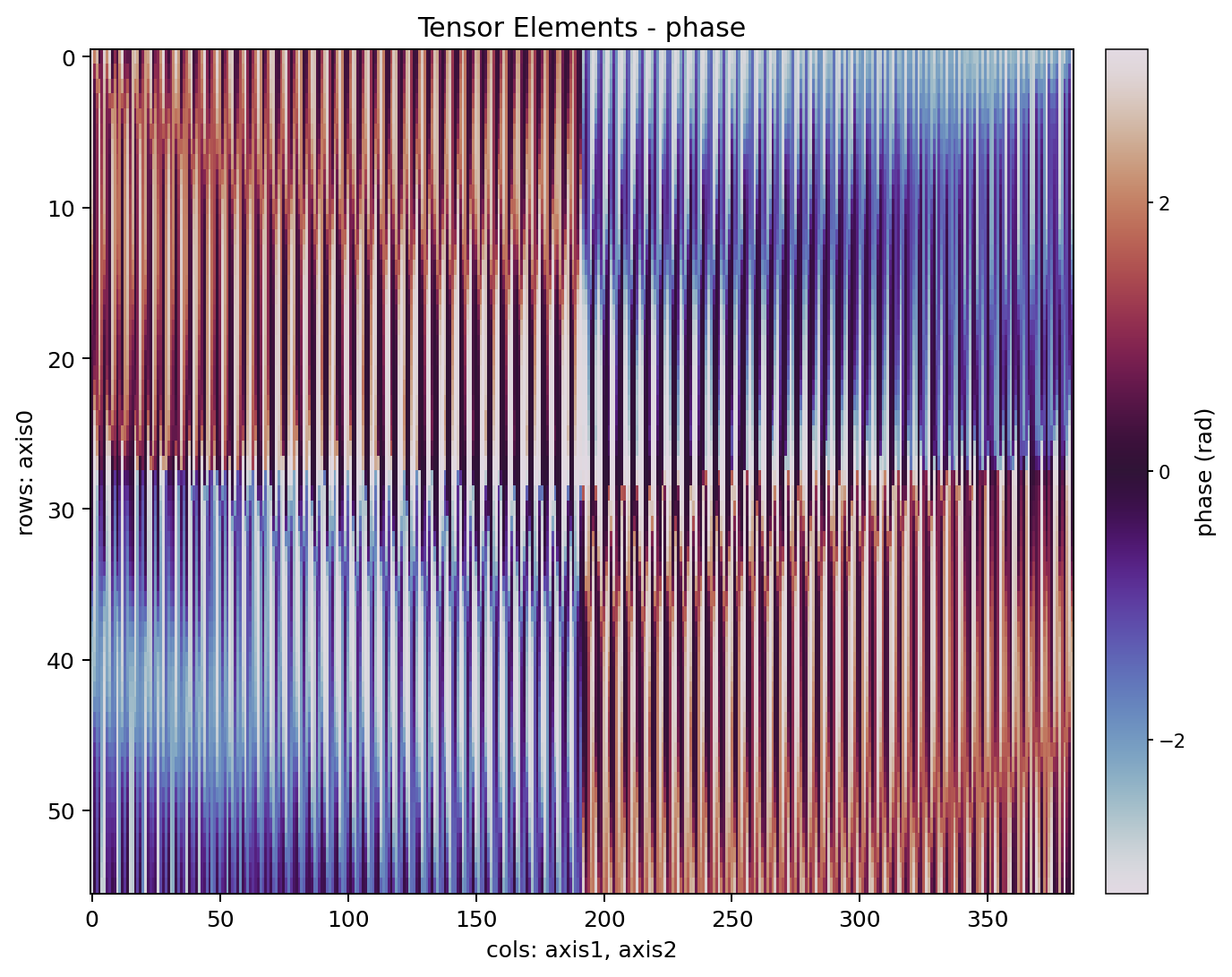
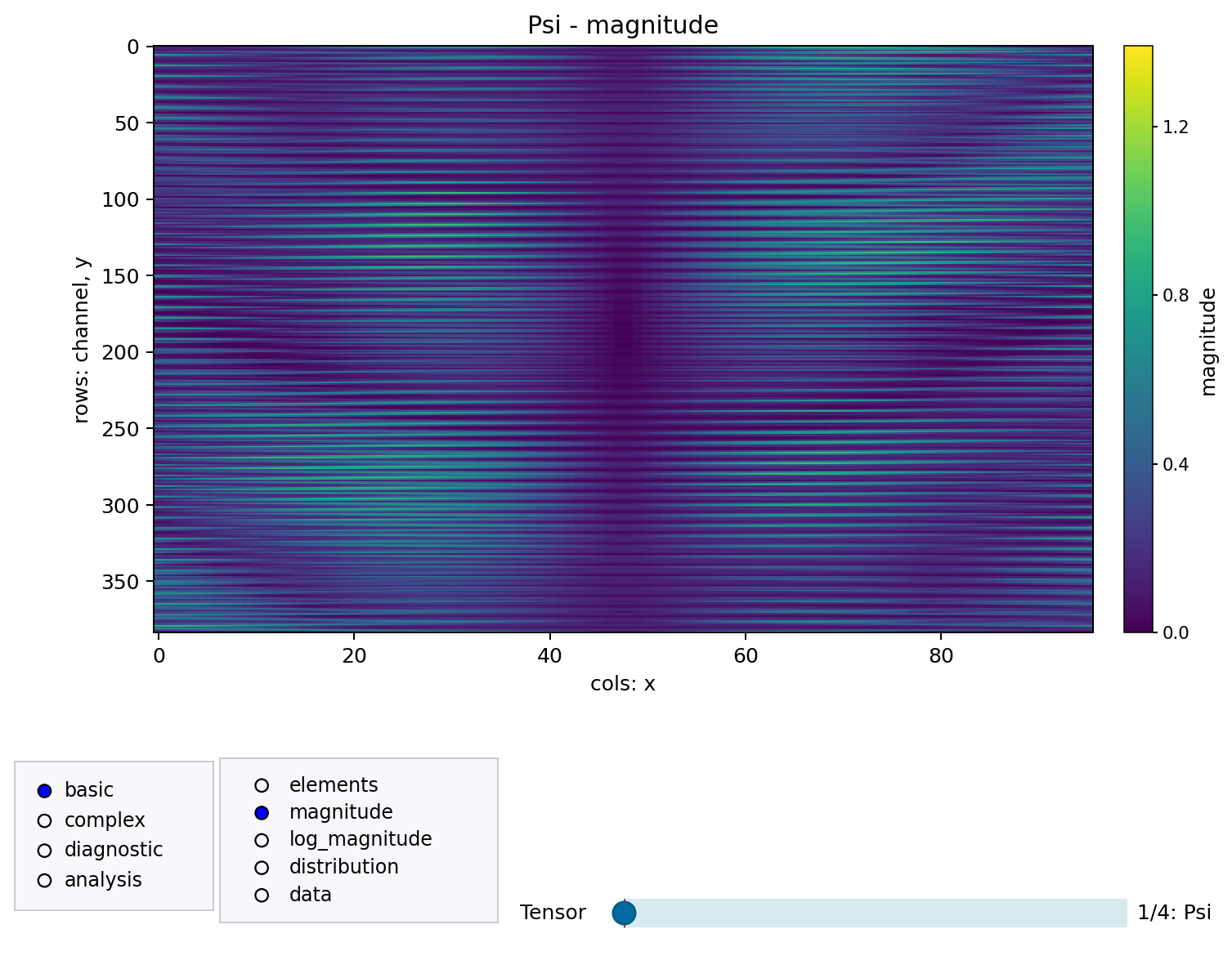
When several tensors are present, the figure keeps one tensor active at a time and uses a slider to switch between them. The interactive controls are grouped: basic (elements, magnitude, log_magnitude, distribution, data), complex (real, imag, phase), and diagnostic (sign, signed_value, sparsity, nan_inf).

  • data: single tensor, iterable of tensors, supported backend-native tensor collections, or an EinsumTrace with live tensor values.
  • engine: optional backend override. If omitted, the library auto-detects it.
  • config: tensor-inspection behavior lives here.
  • data mode now includes global stats, per-axis summaries, and top-k coordinates by magnitude.
  • ax: render a single tensor into an existing Matplotlib axis.
  • show_controls: if True, add compact Matplotlib group + mode controls and, when needed, a tensor slider.
  • show: if False, nothing is displayed automatically.

PlotConfig

Use PlotConfig for visual behavior:

from tensor_network_viz import PlotConfig

config = PlotConfig(
    show_tensor_labels=True,
    show_index_labels=False,
    hover_labels=True,
    show_contraction_scheme=False,
    tensor_label_refinement="auto",
)

This is where you configure:

  • labels,
  • hover tooltips,
  • contraction-scheme overlays,
  • styling,
  • layout iterations,
  • custom positions,
  • label-refinement policy,
  • static/export-oriented rendering choices.

TensorElementsConfig

Use TensorElementsConfig for tensor inspection behavior:

from tensor_network_viz import TensorElementsConfig

config = TensorElementsConfig(
    mode="auto",
    max_matrix_shape=(256, 256),
    histogram_bins=40,
    topk_count=8,
    robust_percentiles=(1.0, 99.0),
    shared_color_scale=False,
    highlight_outliers=False,
)

This is where you configure:

  • the active inspection mode,
  • row/column axis grouping for rank > 2 tensors,
  • heatmap downsampling limits,
  • histogram sampling and bin count,
  • data-summary depth (topk_count),
  • optional robust/shared scaling and outlier overlays.

If you want to start in a specific grouped view, pass mode="real", mode="imag", mode="phase", mode="log_magnitude", mode="sparsity", mode="nan_inf", mode="sign", or mode="signed_value" directly in TensorElementsConfig(...).

Most Common Workflows

Interactive figure with controls

from tensor_network_viz import PlotConfig, show_tensor_network

fig, ax = show_tensor_network(
    network,
    config=PlotConfig(
        show_tensor_labels=False,
        show_index_labels=False,
        hover_labels=True,
    ),
)

Clean export with no embedded controls

from tensor_network_viz import PlotConfig, show_tensor_network

fig, ax = show_tensor_network(
    network,
    config=PlotConfig(
        show_tensor_labels=True,
        show_index_labels=False,
    ),
    show_controls=False,
    show=False,
)
fig.savefig("network.png", bbox_inches="tight")

Inspect tensor values

from tensor_network_viz import TensorElementsConfig, show_tensor_elements

fig, ax = show_tensor_elements(
    trace,
    config=TensorElementsConfig(mode="auto"),
    show=False,
)
fig.savefig("tensor-elements.png", bbox_inches="tight")

Faster render for large graphs

config = PlotConfig(
    tensor_label_refinement="never",
    layout_iterations=120,
)

Copy-Paste Examples by Backend

The library supports auto-detection, but using engine=... in examples is often clearer.

TensorKrowch

import tensorkrowch as tk
from tensor_network_viz import PlotConfig, show_tensor_network

network = tk.TensorNetwork(name="demo")
left = tk.Node(shape=(2, 2), axes_names=("a", "b"), name="L", network=network)
right = tk.Node(shape=(2, 2), axes_names=("b", "c"), name="R", network=network)
left["b"] ^ right["b"]

fig, ax = show_tensor_network(
    network,
    engine="tensorkrowch",
    config=PlotConfig(show_tensor_labels=True),
)

TensorNetwork

import numpy as np
import tensornetwork as tn
from tensor_network_viz import PlotConfig, show_tensor_network

left = tn.Node(np.ones((2, 2)), name="L", axis_names=("a", "b"))
right = tn.Node(np.ones((2, 2)), name="R", axis_names=("b", "c"))
left["b"] ^ right["b"]

fig, ax = show_tensor_network(
    [left, right],
    engine="tensornetwork",
    config=PlotConfig(show_tensor_labels=True),
)

Quimb

import numpy as np
import quimb.tensor as qtn
from tensor_network_viz import PlotConfig, show_tensor_network

tensors = [
    qtn.Tensor(np.ones((2, 3)), inds=("i0", "b0"), tags={"T0"}),
    qtn.Tensor(np.ones((3, 2)), inds=("b0", "i1"), tags={"T1"}),
]
network = qtn.TensorNetwork(tensors)

fig, ax = show_tensor_network(
    network,
    engine="quimb",
    config=PlotConfig(show_tensor_labels=True),
)

TeNPy

from tenpy.networks.mps import MPS
from tenpy.networks.site import SpinHalfSite
from tensor_network_viz import PlotConfig, show_tensor_network

sites = [SpinHalfSite() for _ in range(4)]
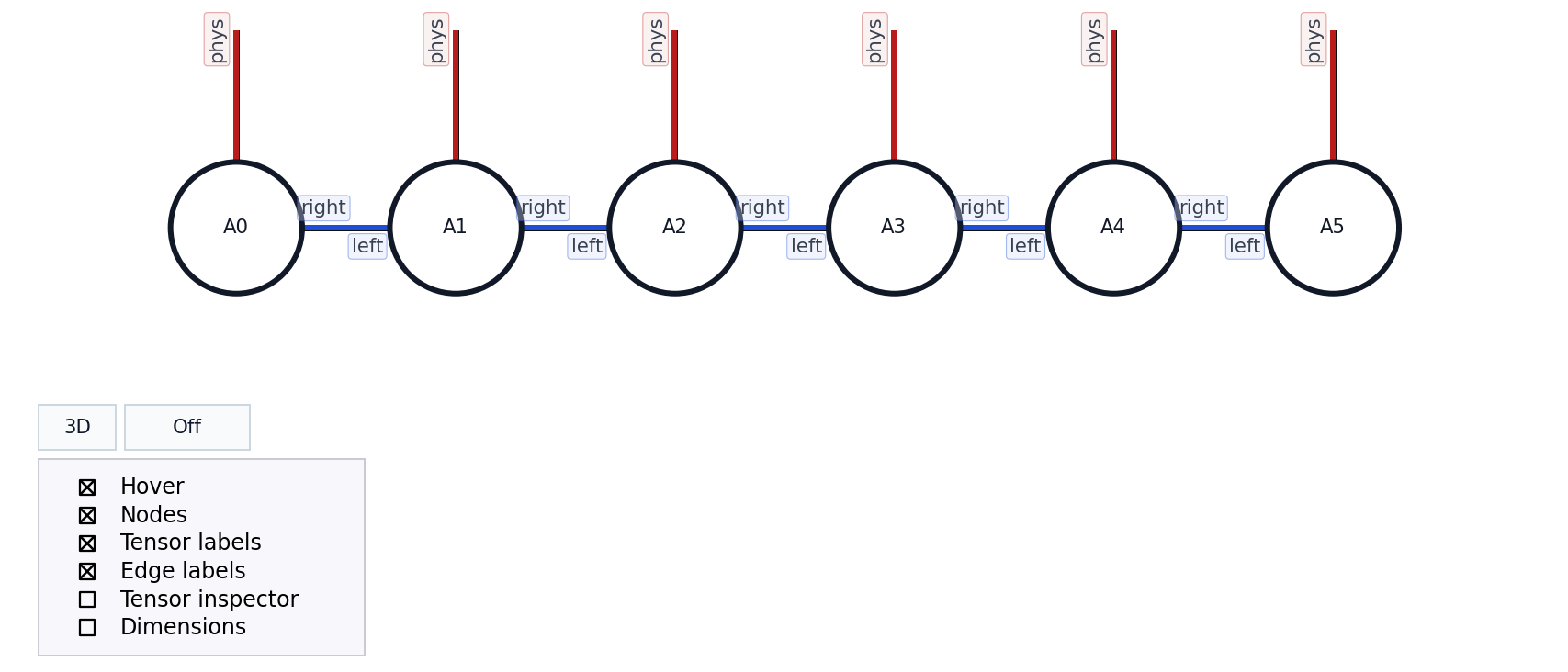
mps = MPS.from_product_state(sites, ["up", "up", "up", "up"], bc="finite")

fig, ax = show_tensor_network(
    mps,
    engine="tenpy",
    config=PlotConfig(show_tensor_labels=True),
    show_controls=False,
    show=False,
)

einsum

from tensor_network_viz import PlotConfig, pair_tensor, show_tensor_network

trace = [
    pair_tensor("A0", "x0", "r0", "pa,p->a"),
    pair_tensor("r0", "A1", "r1", "a,apb->pb"),
]

fig, ax = show_tensor_network(
    trace,
    engine="einsum",
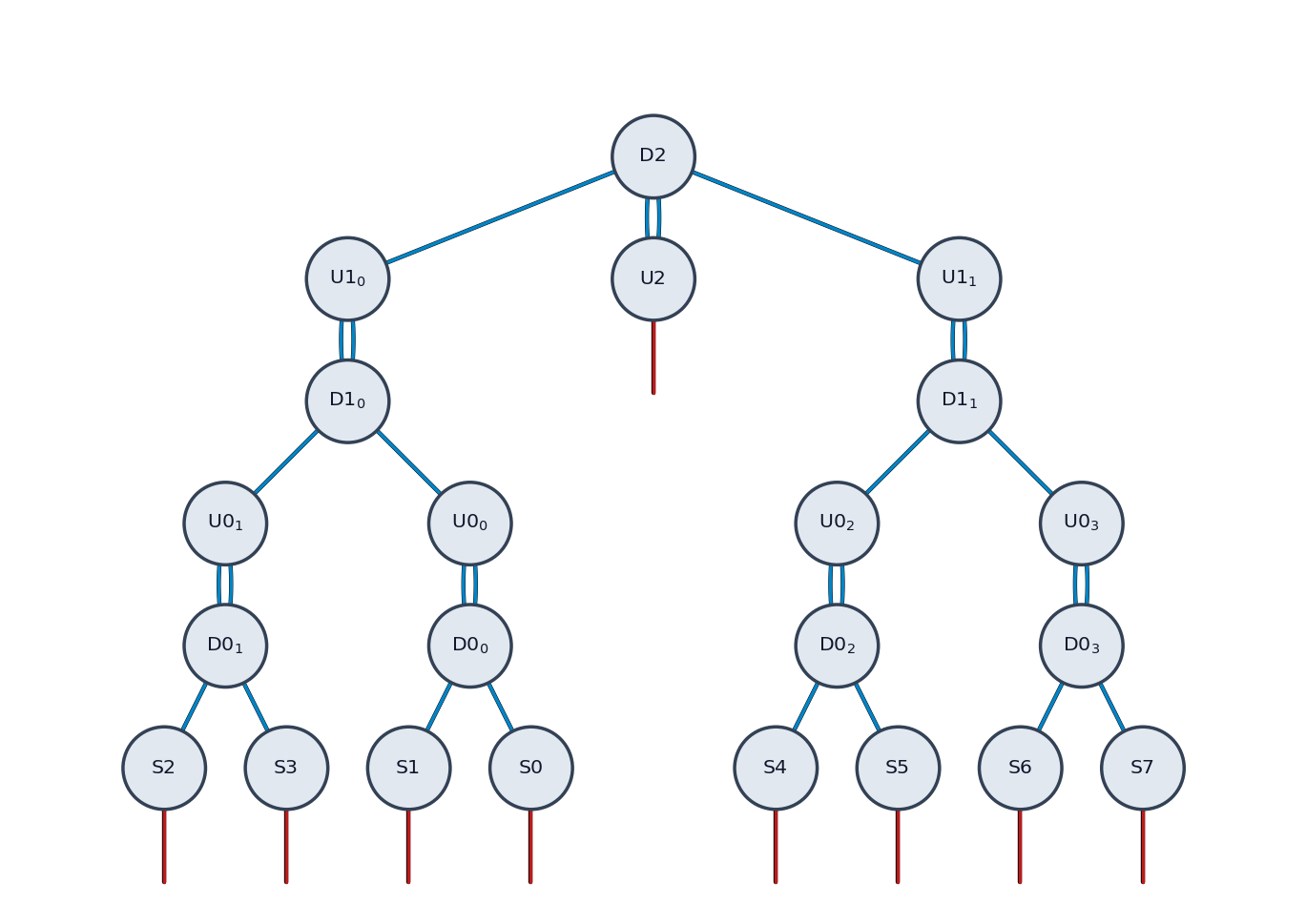
    config=PlotConfig(show_contraction_scheme=True),
)

For fuller backend examples, see docs/backends.md.

PlotConfig Fields You Will Actually Use Often

Field Why it matters
show_tensor_labels Draw tensor names on nodes.
show_index_labels Draw index labels on bonds and dangling legs.
hover_labels Enable hover tooltips in interactive sessions.
show_contraction_scheme Draw contraction-step regions.
contraction_playback Start with playback controls enabled when controls are shown.
contraction_scheme_cost_hover Show contraction details in the playback panel.
tensor_label_refinement "auto", "always", or "never" for the expensive label-fit pass.
layout_iterations Force-layout effort.
positions Supply custom node coordinates.
figsize Matplotlib figure size when the figure is created internally.

Example Launcher

The repository ships a typed demo launcher:

python examples/run_demo.py <engine> <example> [options]

Useful examples:

python examples/run_demo.py quimb hyper --view 2d
python examples/run_demo.py tenpy chain --view 2d --save tenpy_chain.png --no-show
python examples/run_demo.py einsum ellipsis --view 3d --scheme

More details, including an exhaustive copy-paste command list for every CLI example: examples/README.md

There is also a minimal inspection example that only uses base dependencies:

python examples/tensor_elements_demo.py

Troubleshooting

Symptom What to try
Saved figure includes buttons/sliders Use show_controls=False.
Hover tooltips do nothing Use an interactive Matplotlib backend; hover is not useful for PNG-only runs.
Big graphs are slow Set tensor_label_refinement="never", reduce layout_iterations, or pass positions.
Unsupported tensor network engine Install the matching extra or pass the correct backend object.
show_tensor_elements(...) fails on TensorKrowch nodes Materialize the node tensors first; shape-only nodes do not expose element values.
show_tensor_elements(...) fails on manual pair_tensor(...) lists Use an EinsumTrace with live tensors instead; manual trace steps only describe contractions.
Blank / duplicate Jupyter figure Assign fig, ax = show_tensor_network(...) instead of leaving the tuple as the last line.

Documentation Map

Development

Create and use a local virtual environment:

python -m venv .venv
.\.venv\Scripts\Activate.ps1
python -m pip install -r requirements.dev.txt

Run the project checks:

.\.venv\Scripts\python scripts\verify.py

About

2D and 3D tensor network visualization, designed for torch, numpy, quimb, tensorkrowch, tenpy and tensornetwork compatibility

Topics

Resources

License

Code of conduct

Contributing

Stars

Watchers

Forks

Packages


Contributors

Languages