
Open-source cross-agent memory layer for coding agents.
Tiered MCP support across Cursor, Claude Code, Codex, Windsurf, Gemini CLI, GitHub Copilot, Kiro, OpenCode, Antigravity, and Trae.





Three-Layer Memory | Team Collaboration | Workspace Sync | Multi-Agent Orchestration | Dashboard
Chinese | Quick Start | Docker | Supported Clients | Common Workflows | Documentation | Setup Guide
Using Memorix through Cursor, Windsurf, Claude Code, Codex, or another AI coding agent? Read the Agent Operator Playbook for the agent-facing install, MCP, hook, and troubleshooting rules.
Memorix is a local-first memory control plane for coding agents.
It keeps project memory, reasoning context, Git-derived facts, and optional collaboration state in one place so you can continue work across IDEs, sessions, terminals, and autonomous agent runs without losing project truth.
For most users, the default path is simple: use the local TUI/CLI or connect one IDE over stdio MCP. Treat HTTP as the shared-control-plane mode you opt into when you specifically want the dashboard, one long-lived background service, or collaboration state shared across multiple clients.
Most coding agents remember only the current thread. Memorix gives them a shared, persistent memory layer across IDEs, sessions, and projects.
| 🧠 Three-Layer Memory | Observation (what/how), Reasoning (why/trade-offs), Git Memory (immutable commit-derived facts with noise filtering) |
| 🔍 Source-Aware Retrieval | "What changed" queries favor Git Memory; "why" queries favor reasoning; project-scoped by default, global on demand |
| ⚙️ Memory Quality Pipeline | Formation (LLM-assisted evaluation), dedup, consolidation, retention with exponential decay — memory stays clean, not noisy |
| 🔄 Workspace & Rules Sync | One command to migrate MCP configs, workflows, rules, and skills across Cursor, Windsurf, Claude Code, Codex, Copilot, Kiro, etc. |
| 👥 Team Collaboration | Opt-in collaboration state for autonomous agents: task board with role-based claiming, inter-agent messaging, advisory file locks, situational-awareness poll |
| 🤖 Multi-Agent Orchestration | memorix orchestrate runs a structured coordination loop — plan → parallel execution → verify → fix → review — with capability routing and worktree isolation |
| 📋 Session Lifecycle | Session start/end with handoff summaries, watermark tracking (new memories since last session), cross-session context recovery |
| 🎯 Project Skills | Auto-generate SKILL.md from memory patterns; promote observations to permanent mini-skills injected at session start |
| 📊 Dashboard | Local web UI for browsing memories, Git history, active collaboration state, and task board — team views require the HTTP control plane |
| 🔒 Local & Private | SQLite as canonical store, Orama for search, no cloud dependency — everything stays on your machine |
| Tier | Clients |
|---|---|
| ★ Core | Claude Code, Cursor, Windsurf |
| ◆ Extended | GitHub Copilot, Kiro, Codex |
| ○ Community | Gemini CLI, OpenCode, Antigravity, Trae |
Core = full hook integration + tested MCP + rules sync. Extended = hook integration with platform caveats. Community = best-effort hooks, community-reported compatibility.
If a client can speak MCP and launch a local command or HTTP endpoint, it can usually connect to Memorix even if it is not in the list above yet.
Install globally:
npm install -g memorixInitialize Memorix config:
memorix initmemorix init lets you choose between Global defaults and Project config.
Memorix uses two files with two roles:
memorix.ymlfor behavior and project settings.envfor secrets such as API keys
Then pick the path that matches what you want to do:
| You want | Run | Best for |
|---|---|---|
| Interactive terminal workbench | memorix |
Default starting point for local search, chat, memory capture, and diagnostics |
| Quick MCP setup inside one IDE | memorix serve |
Default MCP path for Cursor, Claude Code, Codex, Windsurf, Gemini CLI, and other stdio clients |
| Dashboard + shared HTTP MCP in the background | memorix background start |
A long-lived shared control plane for the dashboard, multiple clients, or collaboration state |
| Foreground HTTP mode for debugging or a custom port | memorix serve-http --port 3211 |
Manual supervision, debugging, custom launch control |
Most users should choose one of the first two options above. Move to HTTP only when you intentionally want the dashboard, one shared background service, or multi-client collaboration.
Common paths:
| Goal | Use | Why |
|---|---|---|
| Work directly in the terminal | memorix or memorix <command> |
CLI/TUI is the primary product surface. |
| Connect an IDE or coding agent over MCP | memorix serve first; HTTP + memorix_session_start when needed |
Start a lightweight memory session without joining team by default. |
| Run autonomous multi-agent execution | memorix orchestrate |
Structured plan → spawn → verify → fix → review loop with CLI agents. |
| Watch shared project memory in the browser | memorix background start + dashboard |
Shared HTTP control plane plus dashboard for memory and opt-in collaboration state. |
Companion commands: memorix background status|logs|stop. For multi-workspace HTTP sessions, bind with memorix_session_start(projectRoot=...).
Deeper details on startup, project binding, config precedence, and agent workflows: docs/SETUP.md and the Agent Operator Playbook.
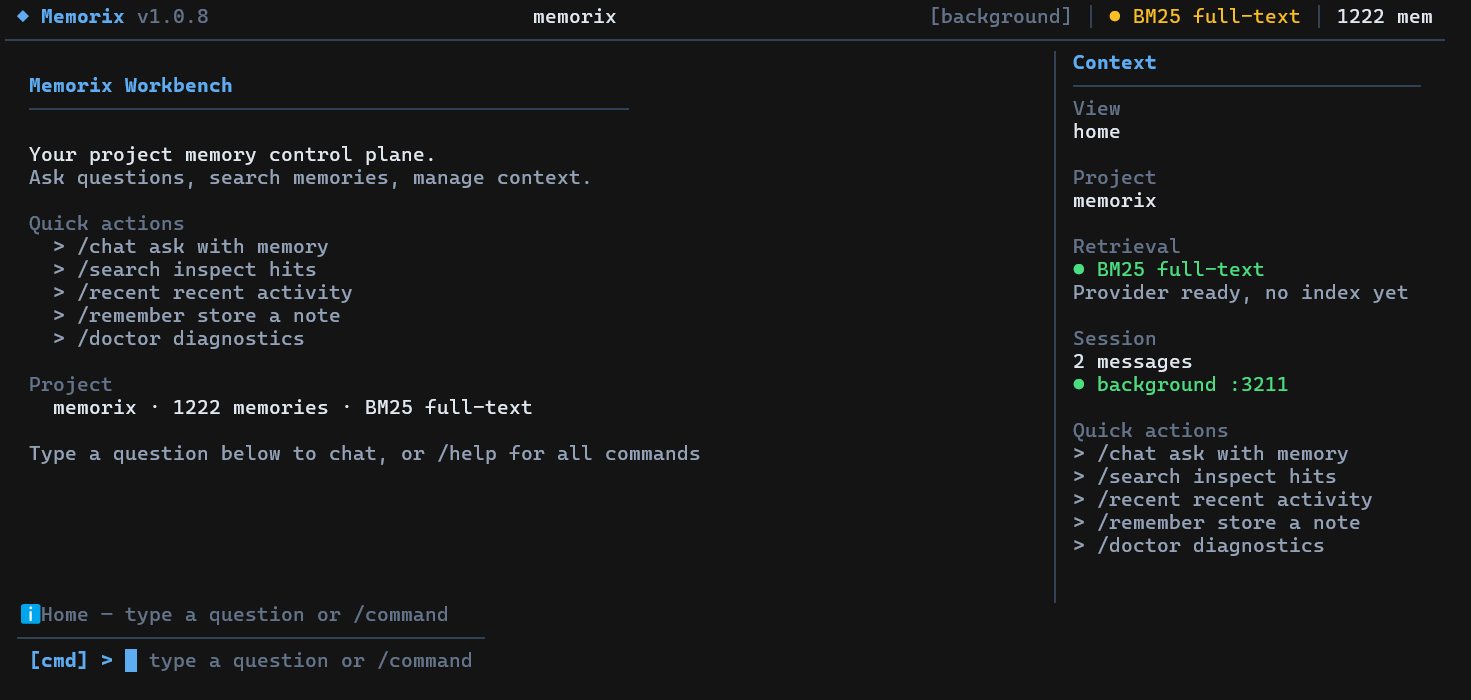
Running memorix without arguments opens an interactive fullscreen terminal UI (requires a TTY). Use it for chat with project memory, search, quick memory capture, diagnostics, background service control, dashboard launch, and IDE setup. Press /help inside the TUI for the current command list.
Single-shot chat (no TUI): memorix ask "your question".
Memorix exposes a CLI-first operator surface. Use it when you want to inspect or control the current project directly from a terminal. MCP remains the integration layer for IDEs and agents.
memorix session start --agent codex-main --agentType codex
memorix memory search --query "docker control plane"
memorix reasoning search --query "why sqlite"
memorix retention status
memorix team status
memorix task list
memorix audit project
memorix sync workspace --action scan
The CLI is intentionally task-shaped, not a 1:1 mirror of MCP tool names. Native capabilities are available through these namespaces: session, memory, reasoning, retention, formation, audit, transfer, skills, team, task, message, lock, handoff, poll, sync, ingest. MCP stays available for IDEs, agents, and optional graph-compatibility tools.
Memorix now includes an official Docker path for the HTTP control plane.
Quick start:
docker compose up --build -dThen connect to:
- dashboard:
http://localhost:3211 - MCP:
http://localhost:3211/mcp - health:
http://localhost:3211/health
Important: Docker support is for serve-http, not memorix serve. Project-scoped Git/config behavior only works when the container can see the repositories it is asked to bind.
Full Docker guide: docs/DOCKER.md
Add Memorix to your MCP client:
{
  "mcpServers": {
    "memorix": {
      "command": "memorix",
      "args": ["serve"]
    }
  }
}{
"mcpServers": {
"memorix": {
"transport": "http",
"url": "http://localhost:3211/mcp"
}
}
}The per-client examples below show the simplest stdio shape. If you prefer the shared HTTP control plane, keep the generic HTTP block above and use the client-specific variants in docs/SETUP.md.
Cursor | .cursor/mcp.json
{
  "mcpServers": {
    "memorix": {
      "command": "memorix",
      "args": ["serve"]
    }
  }
}
Claude Code
claude mcp add memorix -- memorix serveCodex | ~/.codex/config.toml
[mcp_servers.memorix]
command = "memorix"
args = ["serve"]
For the full IDE matrix, Windows notes, and troubleshooting, see docs/SETUP.md.
| You want to... | Use this | More detail |
|---|---|---|
| Save and retrieve project memory | memorix memory store/search/detail/resolve or MCP memorix_store/search/detail/resolve |
API Reference |
| Capture Git truth | memorix git-hook --force, memorix ingest commit, memorix ingest log |
Git Memory Guide |
| Run dashboard + HTTP MCP | memorix background start |
Setup Guide, Docker |
| Keep memory-only sessions lightweight | memorix_session_start(projectRoot=...) or memorix session start |
Agent Operator Playbook |
| Join opt-in collaboration | memorix session start --joinTeam or memorix team join |
TEAM.md, API Reference |
| Run autonomous multi-agent work | memorix orchestrate --goal "..." |
API Reference |
| Sync agent configs/rules | memorix sync workspace ..., memorix sync rules ... |
Setup Guide |
| Use Memorix from code | import { createMemoryClient } from 'memorix/sdk' |
API Reference |
The most common loop is deliberately small:
memorix memory store --text "Auth tokens expire after 24h" --title "Auth token TTL" --entity auth --type decision
memorix memory search --query "auth token ttl"
memorix session start --agent codex-main --agentType codex
When multiple HTTP sessions are open at once, each session should bind itself with memorix_session_start(projectRoot=...) before using project-scoped memory tools.
HTTP MCP sessions idle out after 30 minutes by default. If your client does not automatically recover from stale HTTP session IDs, set a longer timeout before starting the control plane:
MEMORIX_SESSION_TIMEOUT_MS=86400000 memorix background start # 24hTeam collaboration is not the normal memory startup path and it is not a chat room between IDE windows. Join team only when you need tasks, messages, locks, or a structured autonomous-agent workflow. For real multi-agent execution, prefer:
memorix orchestrate --goal "Add user authentication" --agents claude-code,cursor,codexMemorix is designed to stay light during normal memory use:
- stdio MCP starts on demand and exits with the client
- HTTP background mode is one local Node process plus SQLite/Orama state
- LLM enrichment is optional; without API keys, Memorix falls back to local heuristic dedup/search
- the heavier paths are build/test, Docker image builds, dashboard browsing, large imports, and optional LLM-backed formation
On this Windows development machine, the healthy HTTP control plane was observed at about 16 MB working set after several hours idle. Treat that as a local observation, not a cross-platform guarantee. See Performance and Resource Notes for knobs and trade-offs.
Import Memorix directly into your own TypeScript/Node.js project — no MCP or CLI needed:
import { createMemoryClient } from 'memorix/sdk';

const client = await createMemoryClient({ projectRoot: '/path/to/repo' });

// Store a memory
await client.store({
  entityName: 'auth-module',
  type: 'decision',
  title: 'Use JWT for API auth',
  narrative: 'Chose JWT over session cookies for stateless API.',
});

// Search
const results = await client.search({ query: 'authentication' });

// Retrieve, resolve, count
const obs = await client.get(1);
const all = await client.getAll();
await client.resolve([1, 2]);

await client.close();
Three subpath exports:
| Import | What you get |
|---|---|
memorix/sdk |
createMemoryClient, createMemorixServer, detectProject, all types |
memorix/types |
Type-only — interfaces, enums, constants |
memorix |
MCP stdio entry point (not for programmatic use) |

Memorix is not a single linear pipeline. It accepts memory from multiple ingress surfaces, persists it across multiple substrates, runs several asynchronous quality/indexing branches, and exposes the results through different retrieval and collaboration surfaces.
- Observation Memory: what changed, how something works, gotchas, problem-solution notes
- Reasoning Memory: why a choice was made, alternatives, trade-offs, risks
- Git Memory: immutable engineering facts derived from commits
- Default search is project-scoped
scope="global"searches across projects- Global hits can be opened explicitly with project-aware refs
- Source-aware retrieval boosts Git memories for "what changed" questions and reasoning memories for "why" questions
📖 Docs Map — fastest route to the right document.
| Section | What's Covered |
|---|---|
| Setup Guide | Install, stdio vs HTTP control plane, per-client config |
| Docker Deployment | Official container image path, compose, healthcheck, and path caveats |
| Performance | Resource profile, idle/runtime costs, optimization knobs |
| Configuration | memorix.yml, .env, project overrides |
| Agent Operator Playbook | Canonical AI-facing guide for installation, binding, hooks, troubleshooting |
| Architecture | System shape, memory layers, data flows, module map |
| API Reference | MCP / HTTP / CLI command surface |
| Git Memory Guide | Ingestion, noise filtering, retrieval semantics |
| Development Guide | Contributor workflow, build, test, release |
Additional deep references:
- Memory Formation Pipeline
- Design Decisions
- Modules
- Known Issues and Roadmap
- AI Context Note
llms.txtllms-full.txt
Version 1.0.8 builds on the 1.0.7 coordination/storage/team baseline with a CLI-first operator surface, official Docker path, dashboard refinements, and broad hooks fixes.
- CLI-First Product Surface: Every Memorix-native operator capability now has a task-oriented CLI route —
session,memory,reasoning,retention,formation,audit,transfer,skills,team,task,message,lock,handoff,poll,sync,ingest. MCP remains the integration protocol and optional graph-compatibility layer. - Docker Deployment: Official
Dockerfile,compose.yaml, healthcheck,--hostbinding, and DOCKER.md for running the HTTP control plane in a container. - Multi-Agent Orchestrator:
memorix orchestrateruns plan, parallel execution, verification, fix, review, and merge loops across Claude, Codex, Gemini CLI, and OpenCode with capability routing, worktree isolation, and agent fallback. - SQLite Canonical Store: Observations, mini-skills, sessions, and archives in SQLite. Shared DB handle, freshness-safe retrieval, dead
JsonBackendremoved. - Opt-in Collaboration: task board, messages, file locks, handoff artifacts, and collaborator heartbeat state.
session_startis lightweight by default; collaboration identity is opt-in viajoinTeamorteam_manage join. - Dashboard Semantic Layering: Team page filter tabs (Active/Recent/Historical), de-emphasized historical agents, project switcher grouped by real/temporary/placeholder, identity page cleanup.
- Hooks Fixes: OpenCode event-name key mapping +
Bun.spawn→spawnSync; Copilotpwshfallback + global-hooks guard; hook handler diagnostic logging. - Programmatic SDK:
import { createMemoryClient } from 'memorix/sdk'to store, search, get, and resolve observations directly from your own code without MCP or CLI. Also exportscreateMemorixServeranddetectProject. - Test Suite Stabilization: E2e and live-LLM tests are excluded from the default suite, and load-sensitive tests are isolated so the default verification path stays deterministic.
git clone https://github.com/AVIDS2/memorix.git
cd memorix
npm install

npm run dev
npm test
npm run build
Key local commands:
memorix status
memorix dashboard
memorix background start
memorix serve-http --port 3211
memorix git-hook --forceMemorix builds on ideas from mcp-memory-service, MemCP, claude-mem, Mem0, and the broader MCP ecosystem.